You could end world hunger. Or you could invest in AI.

Hi, this is Lisa; I’m responsible for communication at Datawrapper. Today, let’s look at a lot of money and what you could buy with it.
A few weeks ago, big tech companies announced how much they plan to invest in AI infrastructure this year: Amazon ($200 billion), Alphabet (Google, at least $175 billion), Microsoft ($145 billion), and Meta ($115–135 billion).
“It's hard to comprehend the scale of these investments,” a Hacker News user commented. “Comparing them to notable industrial projects, it's almost unbelievable. Every week in 2026 Google will pay for the cost of a Burj Khalifa. Amazon for a Wembley Stadium. Facebook will spend a France-England tunnel every month.”
“Interesting,” I thought. “This does make it easier to comprehend the scale. Let’s continue.” So here’s a comparison of what costs roughly as much as those AI investments:
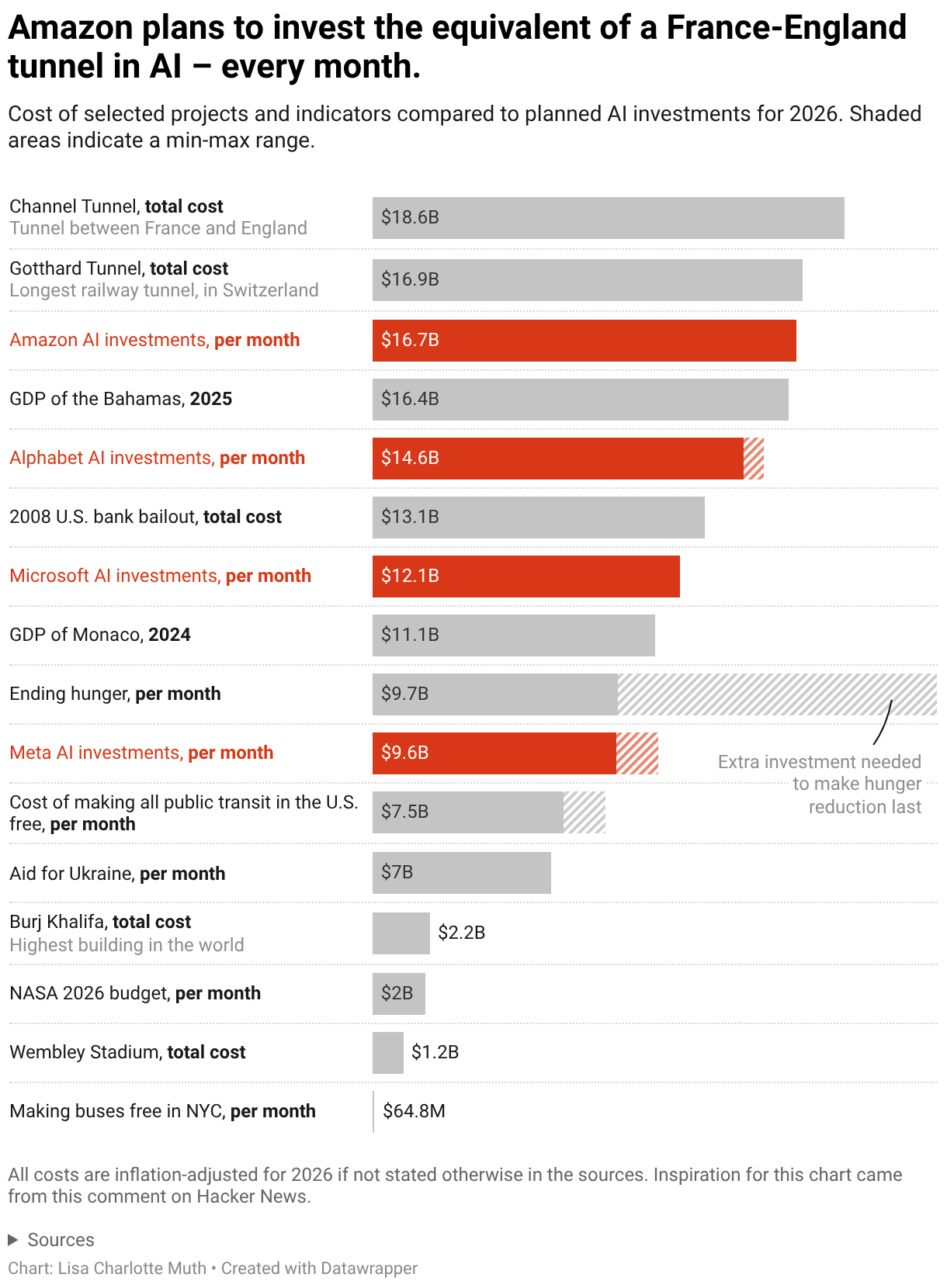
I found these numbers fascinating. Seeing them together lets us compare not only the scale of AI investments with other major projects, but also those alternatives with each other (e.g., the cost of the Burj Khalifa with aid for Ukraine).
“But wait, that’s not how this works.”
Yes, those comparisons are flawed:
They ignore business goals. It’s not like Google or Amazon will start to spend money to end hunger, aid Ukraine, or make buses free tomorrow. Stakeholders wouldn’t be happy because there’s so little return on investment in doing so. Companies spend money on AI because they think it will make them and their stakeholders more in the future, not just for fun (or, you know, for the benefit of humanity).
Investments aren’t mutually exclusive. The bar chart might make you think: “Because we invest in AI, we can’t have x.” (And my clickbait-y headline suggests that, too.) But if and how much the U.S. invests in financial aid to other countries and making public transit free is little dependent on how much companies like Microsoft invest in AI.
And while the numbers give a good ballpark, they’re not necessarily correct:
Estimates. Many of those numbers are estimates. Like the one for ending hunger: we haven’t done it yet, unfortunately, so we don’t know exactly how much it would cost.
What’s included? Some numbers are just one of many possible ones. For example, does the cost for the Channel Tunnel include all maintenance since 1994? (No.) Does the aid for Ukraine include humanitarian aid? (Yes.)
Different building costs. The Channel Tunnel opened over thirty years ago, in 1994. Building mega projects like this was different back then and probably cheaper than today.
You can click on “Sources” at the bottom of the chart above to see more information for every number.
“Months? This has been going on for years!”
Instead of looking at monthly investments in AI, you could also look at yearly or total ones. Last December, Reuters released a very neat comparison, stating: “As of 2024, investors have put nearly $1.6 trillion into this technology boom since 2013,” while “The Apollo program, NASA's decade-long effort to land humans on the Moon, cost about $298 billion.”
But you can always spend more money. According to Reuters, "$3 trillion was invested in railroads during the railroad mania of the 1840s and 1860s." I wouldn’t be surprised if AI investment surpasses that before long.
Thanks for following my little thought experiment. Next time, you'll read our working student Christian's very first Weekly Chart. See you next week!


