From stationed to settled: U.S. bases in Germany

Hi, it’s Alicia from the design team, and in this Weekly Chart, I’m looking at a part of German history that played an important role in my family history as well: U.S. military bases.
Last weekend, I visited family in my hometown, Herzogenaurach, a small town in Bavaria. Over dinner, we ended up talking about how my parents met. My mom is German, my dad is American, and he originally came to Germany with the U.S. Army. Back then, he was stationed in Erlangen, at a base that doesn’t exist anymore.
The town of Herzogenaurach used to have a U.S. base as well. The area was called Herzo Base and still goes by that name today, but by the time I was born, the base had already been closed, and I only know that space as a residential area. This isn’t the only place with a story like that. All over southern Germany, former U.S. bases have been turned into apartment complexes, commercial areas, university campuses, or even solar parks.
So I got curious: How many U.S. bases were there in Germany – and how many are still left?
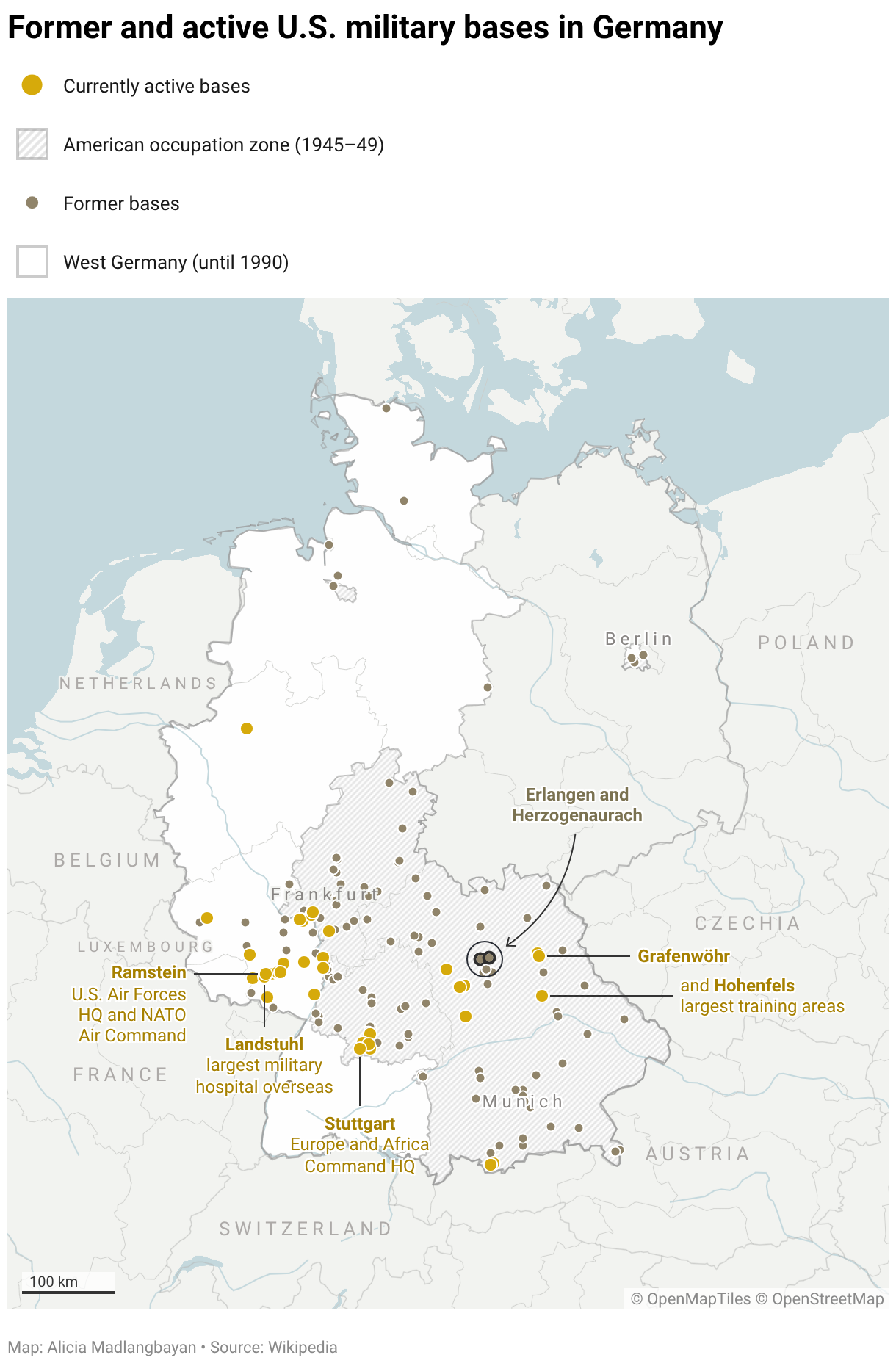
Depending on how you define a “base”, there will be different numbers, but throughout the decades, the U.S. has operated almost fifty major military bases, which were made up of several hundred separate sites. Over 220 primary military installations have already been closed, and only a little over forty remain.
You’ll probably notice right away that overall, the bases are clustered in the south. That’s not a coincidence. The area coincides with the former American, British, and French occupation zones that were set up from 1945 to 1949 following World War II, and that later turned into West Germany. Among the bases still operating today is Ramstein Air Base, which nowadays serves as the headquarters of the U.S. Air Forces in Europe and Africa as well as NATO’s Allied Air Command.
A few other bases still important today are:
Stuttgart: headquarters of U.S. European Command and U.S. Africa Command
Landstuhl: largest U.S. military hospital overseas
Grafenwöhr and Hohenfels: biggest U.S. training areas in Europe
All those dots above represent hundreds and thousands of American soldiers, many of them with their families. For decades, they were part of everyday life in many southern German towns. Then, within just a few years, most of them were gone.

At its peak, more than 250,000 U.S. soldiers were stationed in West Germany. For almost four decades, the number stayed roughly the same. Then the Berlin Wall fell in 1989, the Soviet Union collapsed, and by the mid-1990s, more than two-thirds of U.S. troops were gone. Today, around 38,000 U.S. soldiers are still stationed in Germany.
A new life for the bases — and the soldiers
The U.S. military presence in Germany started out as the occupation force after 1945. During the Cold War, they became the front line against the Soviet Union, and today, they serve as hubs strategically placed in the middle of Europe, including logistics hubs for troops, equipment, and freight, coordination hubs, and satellite relay stations. They support U.S. military operations in the Middle East and Africa and help secure NATO’s eastern flank against Russia. But even this smaller presence is shrinking. Just this year, the U.S. government ordered the withdrawal of another 5,000 soldiers.
My dad arrived in 1989, right before the number of troops dropped fast. But he stayed – because he found love and another job. He came to Germany for a military base that no longer exists, and now works at another one that took on a new role, just like he did.
His old base, Ferris Barracks in Erlangen, closed in June 1994. Part of it was torn down for university and civilian commercial use, but the existing red-brick buildings are historically protected. His old building is now a university dorm.
Herzo Base in our hometown, which started out as a German air base, was taken over by the U.S. Army in 1945 and served as a listening post for U.S. intelligence. The last American soldiers left in 1992. Today, it’s a residential area, a business park, and adidas’ World of Sports headquarters, which happens to be my dad’s office.
Thanks for reading! Maybe there’s a former U.S. base in your town, too – and maybe you’ve walked past it without ever knowing. We’ll see you next week with another Weekly Chart!


