Should we design streets for human mistakes?

Hi, it’s Luc from the visualization team! I love biking in Berlin, even in gloomy November. The fresh autumn air on my face puts me in a good mood for the day. (This morning, I was even blessed by a light drizzle, such a bliss.) But two years ago, I ended up at the hospital. Sadly, Berlin streets are not the safest. Here are some statistics on road collisions and why they still happen in my favorite city in the World.
On a sunny morning in 2024, as I was biking to the Datawrapper office, a car hit me at an intersection. After a big fright and some X-rays, my injuries turned out to be only superficial. I was lucky enough not to be one of the 55 people killed in traffic that year, just one of the 16,480 casualties.
A couple of weeks later, I met up with the car driver. He was worried about my health, felt sorry, and said he “didn’t know what happened”. Obviously, he didn’t intend to hit me. He didn’t even intend to break the law. That left me wondering: how could this happen?
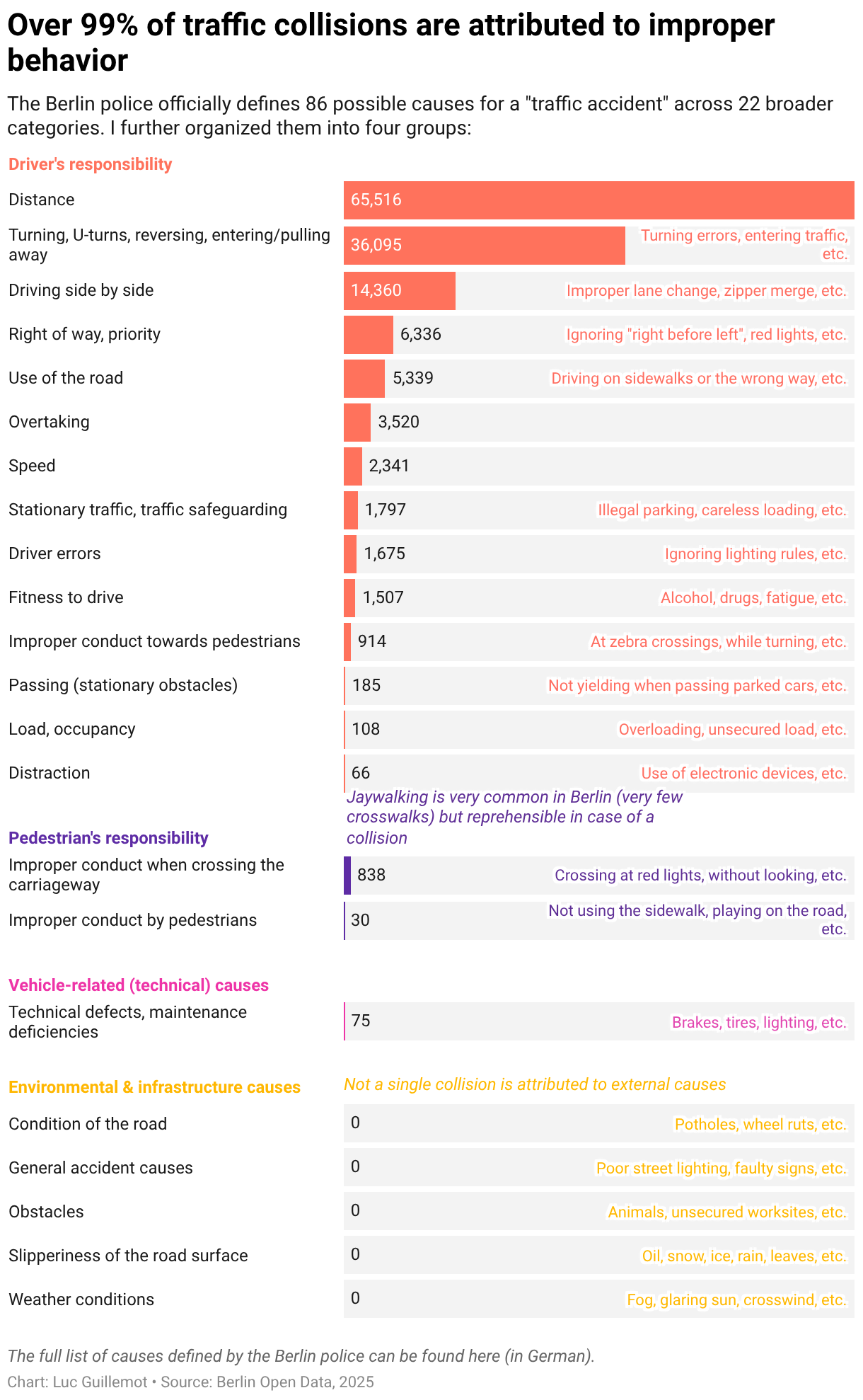
The police investigation quickly concluded it was the car driver’s wrongdoing — the light was green for me at the time of the collision — and he received a fine. Most investigations of traffic collisions arrive at a similar conclusion: the fault almost always falls on someone’s improper behavior. Out of the 137,373 documented collisions that happened in Berlin in 2025, where a clear cause was identified, over 99% of the cases can be categorized as the responsibility of one of the persons involved in the collision.
How and why do so many individuals in Berlin — most likely without any intention of getting into a crash — still end up hurting or killing other users of public space?
Anybody living in Berlin witnesses traffic rules being broken all the time. Whenever we go out for lunch with the team, we walk on a street with a 30km/h speed limit, but every time, cars drive by much faster. There are no crosswalks, so we always have to run between cars speeding by to get to our lunch. Luckily, we have avoided collisions so far, but we do risk our lives every day.
Motonormative punishment, and a better way forward?
Illegal and potentially harmful behaviors are not rare, it’s the norm, a mass behavior. While driving above the speed limit is punishable by law, and there are speed controls in Berlin, how is it even possible to drive so fast? What is the point of defining protective rules that are so easy to break and don’t reduce road violence effectively?
Criminologist Ian Loader defined the concept of motonormative punishment as “a mix of legal sanctions and a culture of blame that focuses on the behaviour of a minority of ‘careless’ or ‘dangerous’ drivers while accommodating the structural violence generated by regimes of automobility”.
Loader proposes a framework for addressing road violence based on five harm-reduction principles:
Diversion: Road violence is a systemic problem. Reducing the distances we drive and diverting traffic to other means of transportation creates less harm.
Design: Redesign streets so cars can’t speed, forbid vehicles that are too heavy, etc.
Distributed agency: Responsibility in crashes is diffused, shared across car manufacturers, urban designers, engineers, drivers, etc.
Deliberative learning: Denormalize road violence and gather all actors of each collision to figure out what happened and how it can be prevented in the future.
Disassembling dangerous actants: Bad driving should have consequences, not in the form of punishment, such as fines, but rather in the form of “civil disqualification”, like losing or suspending a driver’s license, in order to protect others from future risk.
Several cities and countries around the world have already started to treat traffic deaths as a public health issue. Sweden was the trailblazer with the concept of Vision Zero, which focuses on designing cities for safety over convenience.
In Berlin, on the other hand, the number of fatalities has not significantly decreased in the last ten to fifteen years, despite the parliament’s adoption of the Vision Zero principle in its Mobilitätsgesetz in 2018.


I keep biking at the intersection where I was hit. I can’t help thinking about how things could have been different if the road were not so large, if a protected bike lane were built, if lane markings were painted. Would the car driver have seen me then? It’s not that I think he shouldn’t have faced consequences for reckless driving, but I would much rather not get hit at all.
That’s it for this week. Thank you for reading! If you see a car driving at 50+ km/h in the city center, imagine how simple infrastructure like double bends, bollards, speed bumps, or crosswalks could make the city much more peaceful and safe! See you next week. 👋


