Where does my trash go?

Hi, this is Linus from the app team. Today I’m taking a look at what happens to my trash once it leaves my home.
I’ve always been a big fan of recycling. It’s such a simple way to help the environment. When I put a milk carton in the recycling bin at home, I imagine it being turned into something new, which feels great. But there are many people saying, “Why bother sorting? It all goes into the same garbage truck and ends up at the landfill anyway”. If that’s true, does it mean the good feeling that comes with sorting my waste is a lie? Let’s find out!
Most of our waste used to end up in landfills
My trash counts as municipal waste, which Statistics Finland defines as "waste generated in households and waste comparable to household waste generated in production, especially in the service industries. The general common feature of municipal waste is that it is generated in the consumption of final products in communities and is covered by municipal waste management systems."
Living in a Finnish municipality, this is the waste I am contributing to. And here is what happens to it:
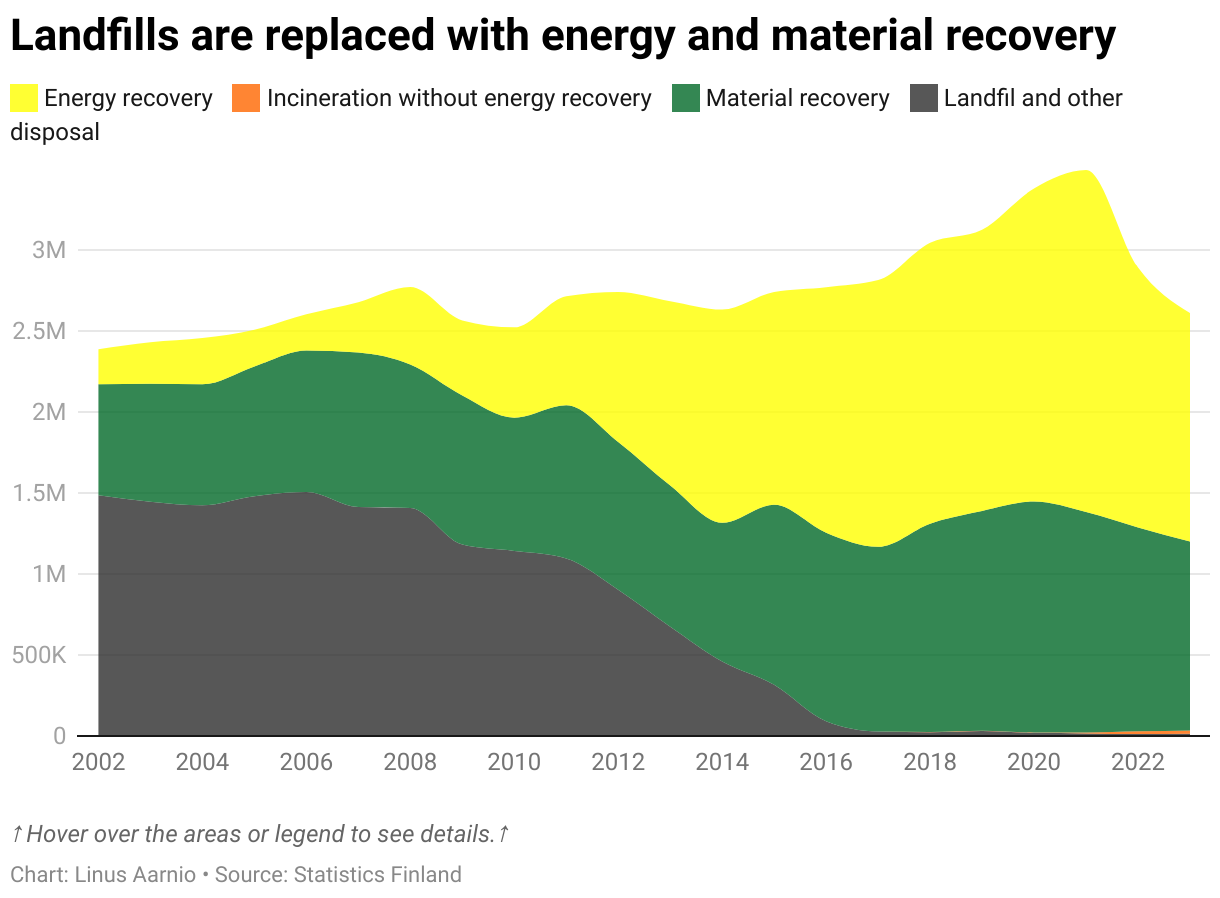
In the early 2000s, most waste did indeed end up in landfills and other disposal sites. But since then, that has been mostly phased out. Finland's municipal waste management is now split between material recovery and energy recovery.
Material recovery is exactly what I imagine happens when recycling: the material put into the bin is eventually used to create a new product of the same material. When buying something that says the packaging is “made of 70% recycled material”, that’s where it comes from.
Energy recovery means the waste is incinerated, which may at first sound bad. But Finland has very modern waste-to-energy plants. There are strict EU limits on emissions from these plants, and in practice, they are often well under the limits. The heat from incineration is used for both electricity and district heating. Finnish waste-to-energy plants produce around 1% of Finland’s electricity and 8-10% of district heating. In these plants, municipal waste accounts for around 70% of the total capacity.
Different types of waste get different treatment
But if most trash still goes to incineration rather than material recovery, and energy recovery is okay, why bother sorting? Putting everything in the trash bin will make it mixed waste, which goes straight to incineration.
Material recovery is still much better, since it saves the resources of our planet: you don’t need to cut down a tree to make cardboard for a new milk carton when recycling the cardboard from an old one. And the share of material recovery is dramatically different for sorted waste and mixed waste.
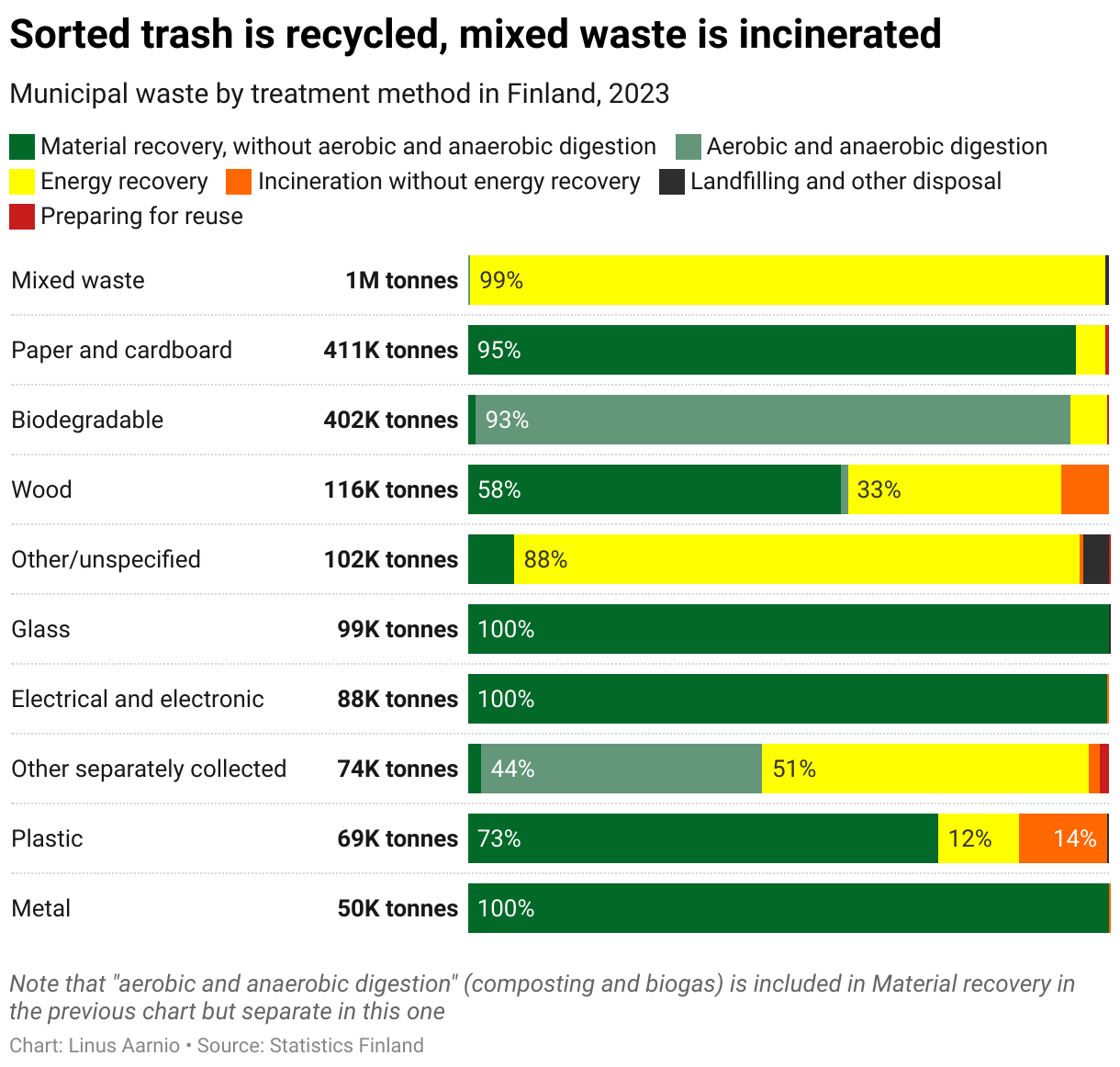
If you throw everything into the same bin, it ends up in “mixed waste”. In Finland, that means there is a 99% chance it goes to energy recovery. When I sort my milk carton into the correct bin, though, there is a 95% chance it is used for new cardboard.
So the waste that is actually sorted is very likely to end up in material recovery. In other words, shifting the scale between energy recovery and material recovery is not up to the government: it’s up to us citizens to sort our trash and take it to the recycling station!
Europe is becoming better at recycling
So far, I have focused on the Finnish recycling system, since that is where my own trash ends up. But of course, Finland is not solely responsible for our shared environment. Other countries have their own systems, and what happens to waste once it is sorted differs in each of them. Looking at the municipal waste treatment in different European countries, the rate of recycling varies a lot. But overall, the situation has been improving, and in some cases, in the 12 years between 2010 and 2022, by a lot.
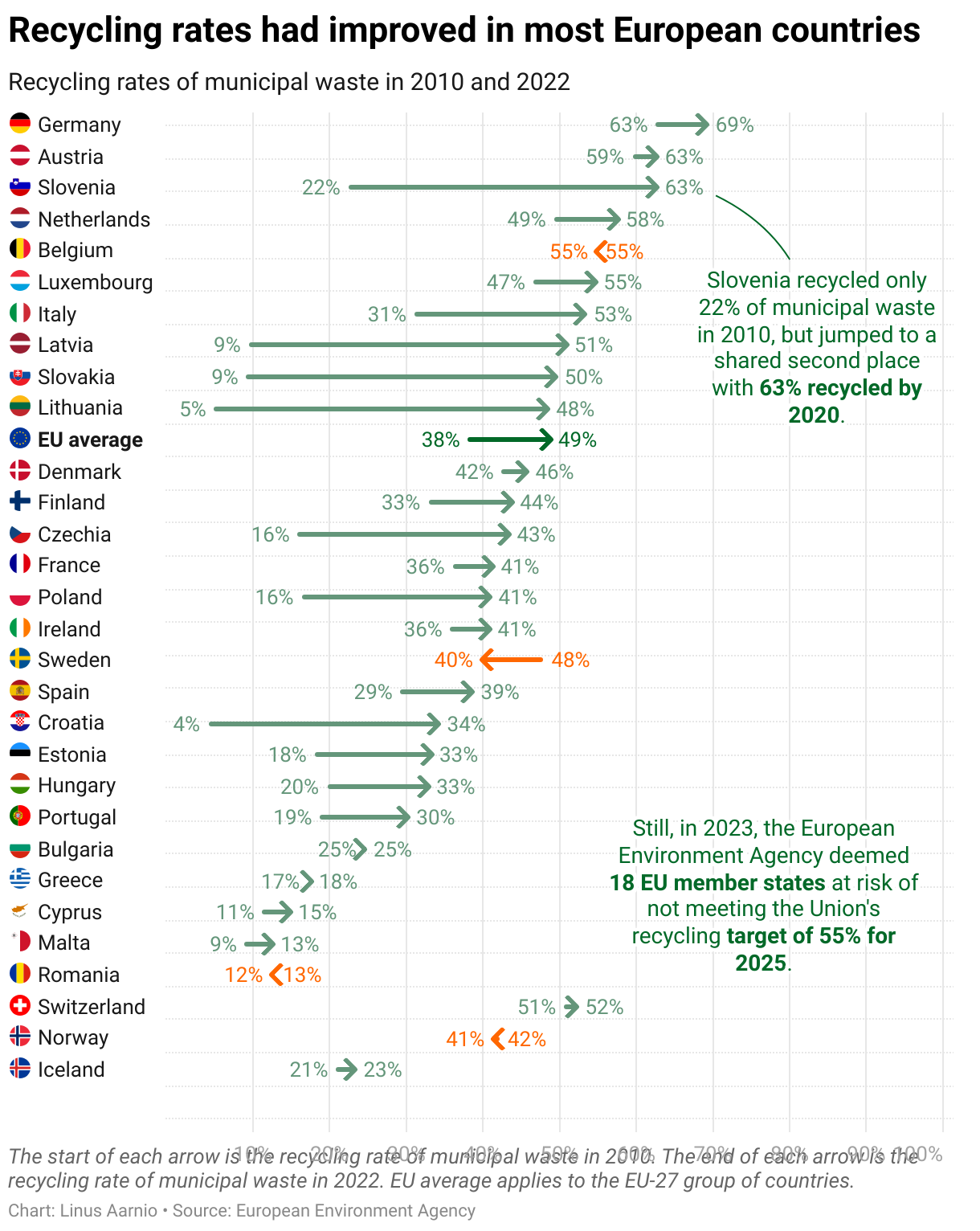
While some countries like Germany have been recycling a lot for a long time and still do a good job, countries like Slovenia, Latvia, and Slovakia have gone from recycling very little to recycling more than the Finnish system. Well done! Other countries still need to do more to catch up.
How do we continue increasing the recycling rates? It will take two things: improvements of the national waste systems, making sure that the collected waste is used for material recovery where possible and energy recovery where not, and each individual sorting their trash to ensure that everything that can end up in material recovery actually goes there.
So to answer the original question: Yes, it’s absolutely worth it to sort my trash here in Finland. And it looks like the same is becoming true in more and more places. I’ll certainly continue doing it, and I believe you should as well.
Thank you for reading and recycling. Check back next week to hear from someone you may be familiar with if you’ve ever contacted Datawrapper's support team, my colleague Ceren.


