Do we really know how many planets are in our solar system?

Hi, this is Alex. I’m part of the design team. Even though I’ve been fascinated by space ever since I was a small child, I recently learned that there is more to our solar system than I thought.
In the school books, you might have learned that our solar system has 9 planets: Mercury, Venus, Earth, Mars, Jupiter, Saturn, Uranus, Neptune, and Pluto. Though, as you might also know, Pluto infamously got its classification as a planet revoked in 2006 and now belongs to the class of dwarf planets. But did you know there are more planets like that?
What even is a planet?
The International Astronomical Union (IAU) is a group of astronomers that names objects in our solar system. Based on their latest definition from 2006, an object has to follow these rules to be classified as a planet:
It must orbit around a star.
It must be big enough that its own gravity forces it into a spherical shape.
It must be big enough that it “cleared” the neighborhood in its orbit.
The decision to change the definitions came after the discovery of many other planet-like objects in our solar system around that time.
What is a dwarf planet?
Dwarf planets are objects that only meet the criteria A and B from above, but not C. So basically, they share their orbit around the sun with other larger or many smaller objects. Criterion C was also the reason why Pluto had its planet status revoked.
Why? Well, Pluto’s mass is only 0.07 times the mass of all objects in its orbit. For comparison, the Earth has the highest ratio, being 1.7 million times more massive than the objects in its orbit (excluding the moon). Mars has the lowest mass of the normal planets, being 5,100 times more massive.1
So it is not purely a planet’s size that makes it a planet. Still, larger objects tend to clear the path of their orbit because of the bigger gravitational influences.
What are the “new” planets then?
The planets in the traditional way (meeting all three criteria) are still our well-known 8 planets. There might even be another Planet X — which hasn’t been discovered and is purely theoretical — but that’s for another day. 😉
Beyond that, there are currently five recognized dwarf planets in our solar system: Pluto, Ceres, Haumea, Makemake, and Eris.
Interestingly, Ceres is the only dwarf planet in the inner solar system. It is located in the asteroid belt and, when it was discovered in 1801, it was considered an asteroid. Ceres was later re-classified as a dwarf planet based on the definition above.
The other four are all located in the trans-Neptunian region, far beyond our most distant planet, Neptune.
In fact, there are many more candidates, including Gonggong, Orcus, Sedna, and Quaoar, that could fit into that category. We just don’t know enough about them (yet) to be sure where they fit in exactly. Scientists expect that there are hundreds or maybe thousands more planets yet to be discovered. Of the officially recognized dwarf planets, only Pluto and Ceres are confirmed to meet criteria B. So — to my surprise — there’s still a lot more to explore in our own solar system!
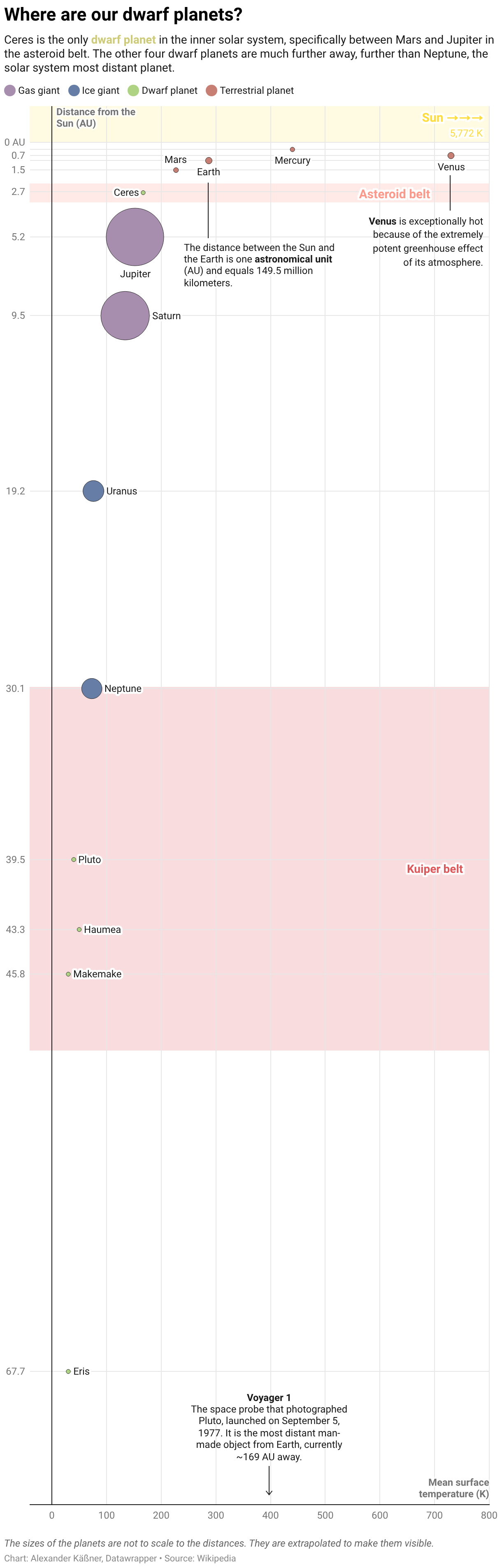
This visualization is heavily inspired by the fantastic infographic of the solar system made by our head of design, David. Give it a read if you want to create one yourself!
Curious to learn more?
If you are interested in more space-related topics, you might want to check out these Weekly Charts from my colleagues:
I’m always astonished by how much we know — and don’t know yet — about the universe. You can check out images of the dwarf planets in the Wikipedia articles linked above or on NASA’s website. For some, we only have pixelated images for now, and it’s crazy how much scientists can make out of them.

I hope you enjoyed this journey through our solar system, and see you next week for a Weekly Chart from Pascal!