Is there a movie remake crisis?

Hello there, Julian here! 👋 My first-ever Weekly Chart asked, “Is there a movie franchise crisis”? This time, I decided to compare original movies and remakes. Some of the questions I want to answer are: Are remakes as bad as their reputation? Are there more remakes today? What type of movies even get remade? And how can I fit all of this in a single chart? Read on to find out how I tackled the challenge.
Remake vs. reboot
A remake is a movie that retells the core story, features the key characters, and fundamental plot points of a previously released movie, generally sticking to the same narrative path.
A reboot is a movie that borrows some elements from the original, like characters or plot, but also replaces some of them, ultimately telling a different variant of the story. Reboots often come after multiple other instalments, such as sequels, prequels, or remakes, that followed the original.
Naturally, the two definitions blur into each other, leaving room for interpretation, as the movies fall on a wide spectrum from picture-by-picture reshoots (e.g., Psycho) to completely new interpretations of characters, storyline, and style (like Spider-Man (2002) vs. Spider-Man: Into the Spider-Verse).
Collecting the data
That is why data selection wasn’t as easy as for my analysis of franchises. Instead of relying on available data, I needed to create my own dataset. It was a manual process of browsing through various lists on the internet and identifying remakes and reboots based on the definitions above.
The final dataset I built contains 140 original movies and 142 remakes — two movies have been remade a second time already. It is far from exhaustive, but good enough for my semi-scientific analysis.
Charting movies, uncovering trends
To get a visual overview of the movies and trends, I set myself a few goals to achieve with the chart:
No aggregation: Every single movie should be visible.
Clear distinction: Originals and remakes must be visually distinguishable.
Relationships: The relationship between the original and remake must be visible.
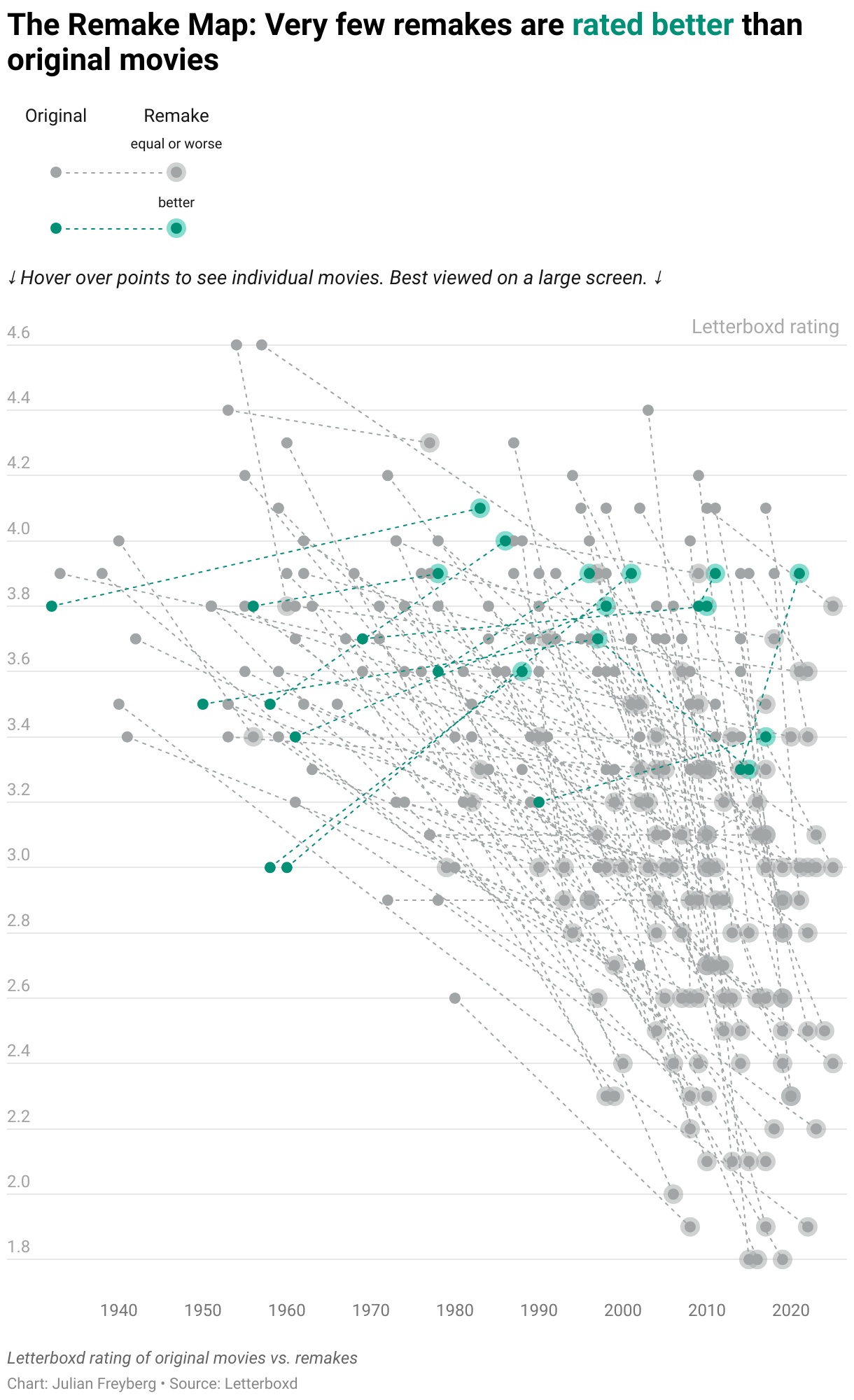
To achieve this, I decided to plot the release year on the x-axis and the movie's rating on the y-axis, connect originals and remakes with a line, and highlight remakes with different markers. I call the resulting graph the Remake Map.
Good original, bad remake?
The first thing you probably notice is the clear downward trend observable throughout the chart. Only 12 out of 142, or ~8% of remakes, outscore their source material, and only 4 of them (~3%) are a lot better (≥ 0.5 score improvement) than the original. The biggest improvement comes from Steven Soderbergh’s Ocean’s Eleven — one of my favorite feel-good movies — which outshines the original with a 3.9 rating compared to the older one's 3.0.
A related and equally interesting observation is that the original movies are mostly good movies to begin with. In my dataset, Prom Night is the original movie with the worst ranking, scoring a low but far from disastrous 2.6. For comparison, about thirty percent of the remakes in the dataset score 2.6 or below - the Prom Night remake being one of them at 1.9. If you're going to remake something, why not pick something bad and try to improve it?
Well, while this logic makes sense if you are measuring improvement (as my chart does), studios don’t get paid for improvement. They may not even care that much about the absolute rating of a movie. Studios focus on the metrics that translate into dollars: box office numbers, streaming views, and hype. In the eyes of studios, a bad movie isn’t a chance for improvement — it’s a losing horse. Just like sequels, prequels, and spin-offs, betting on something that worked well before just makes more sense.
Taking an even closer look, steeper lines (indicating a huge change in rating and/or short time between original and remake) are increasing towards the right side of the chart, painting the picture of quick and bad remakes in the 2010s and onwards. There are also more remakes nowadays, but that could be the result of a lot more movies being released overall.
There is one question that this chart doesn’t answer: What types of movies get remade? While gathering data, I identified three common categories.
The horror remake
Horror is the number one genre of the cinematic remake. Studios love horror movies because they often require comparatively low budgets but can generate great returns. Most don’t, but when an original horror flick strikes gold, it’s rarely a one-hit wonder. Instead, it gets squeezed into a franchise "money machine" — just look at the endless slasher marathons of Halloween or Friday the 13th. But once a series eventually trips over its own feet, the plot lines get truly bizarre, and the machine threatens to break down, studios reach for the reboot, or remake, button.

There are a lot of solid horror movie remakes, but more than half of the 30% lowest rated remakes are horror movies. It looks like these are at the greatest risk of tanking hard.
The Hollywood remake
Another popular target of Hollywood remakes is foreign movies. The strategy is simple: Take a concept that worked well in Asia or Europe, cast some well-known actors, and throw it on the American and international market — the dream of Californication.
When visualized, the situation looks similar to the horror genre's one, which can be partly explained by the fact that there is quite a bit of overlap with the horror genre: 16 out of the 57 Hollywood remakes, 28% of movies in this category are also horror movies.
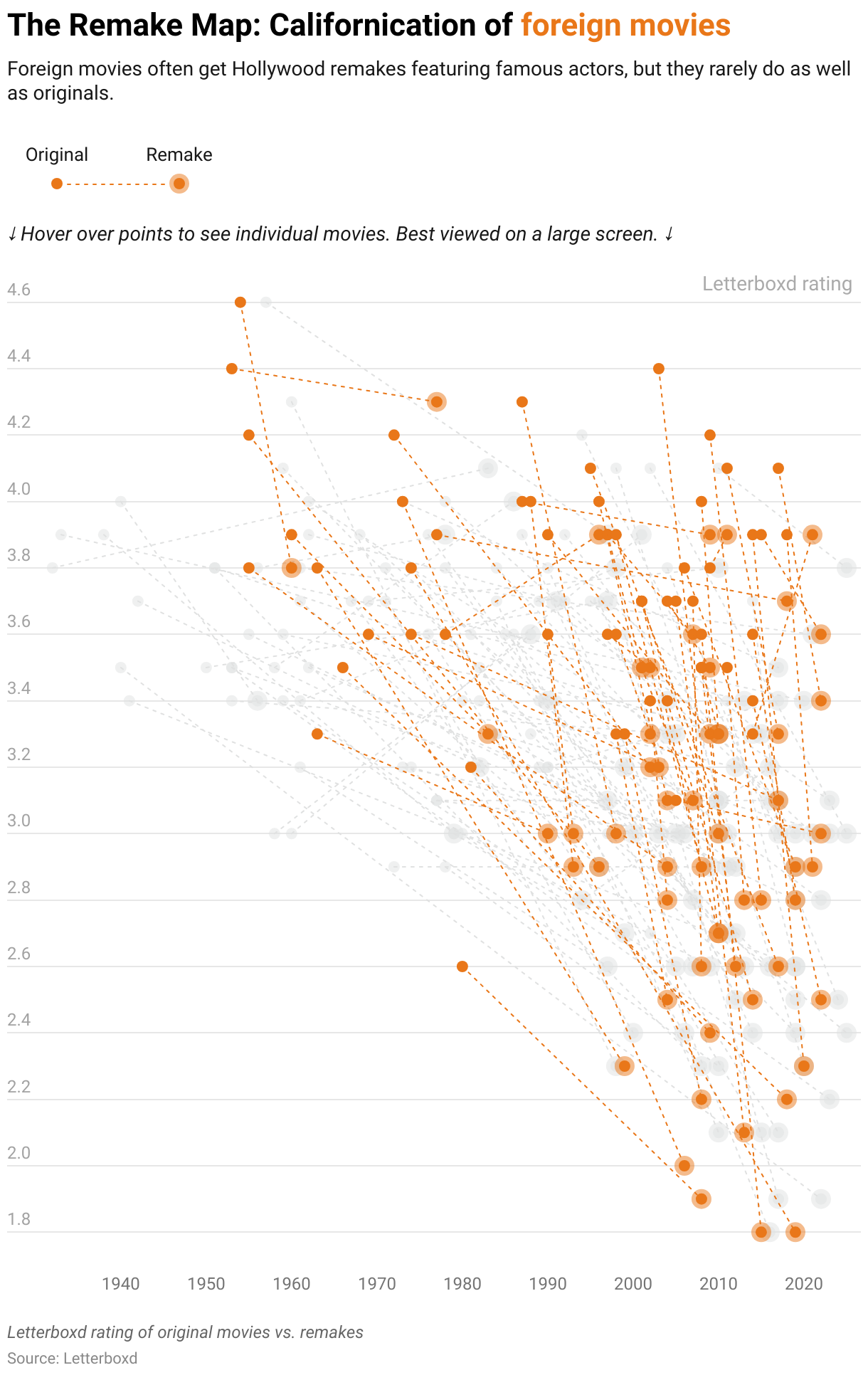
These movies have a tendency to be released only a couple of years after the original, and, unfortunately, they are rarely able to keep up. This category also features the worst remake of them all (well, at least in this dataset): Park Chan-wook’s original Oldboy is rated a massive 4.4; ten years later, the US-remake couldn’t even score half of that, receiving a catastrophic 2.1 rating.
The animated-to-live-action remake
Finally, let’s take a look at a newer and (so far) less populated category, which is live-action remakes. A live-action remake is an adaptation of an animated movie into a film featuring real actors and photorealistic computer-generated imagery. It’s a major film industry trend, pioneered and dominated by Disney.

It’s little surprise that this category has zero overlap with the former two categories, as it is mostly studios recycling their own successful movies decades later. It’s also to be expected that most of these remakes came out very recently, as the whole genre has only been unlocked by recent CGI advancements.
An interesting case is The Jungle Book (1967), which is not only the first movie in the dataset to receive its live-action remake in 1994, but also a second remake in 2016, as one of only two movies mentioned earlier.
Are remakes here to stay? Probably, at least most of them.
Although remakes rarely match the quality of the original, they seem to pay off for studios, and there is no indication they are going anywhere. Disney will probably continue to recycle their IP for as long as it works well at the box office. They got quite a catalog to crunch through. A Moana live action remake has already been announced for next year. Successful and iconic horror movies will also continue to present lucrative opportunities. The one category of remakes that might not have a bright future ahead is the Hollywood makeover of foreign films. International productions are stepping up their game while Netflix and other streaming giants promote and distribute local productions internationally.
So, if you’ve been hoping for an international horror movie to land a lucrative remake deal, the data is in your favor. For the rest of us who won't be winning any Oscars (or Razzies) soon, I hope you still found this Weekly Chart insightful. Join us next week as we release a sequel to the “Which visualization types did you create this year?” series.


