The AI gender gap

Hi, I’m Elliot, and I work on Datawrapper’s visualization code. This week, I’m looking into a surprising demographic difference in tech adoption.
You don’t need me to tell you that ‘artificial intelligence’ is everywhere these days, thanks to ChatGPT and a tidal wave of generative AI services and products it inspired.
Perhaps less well known is the gender gap that has emerged among users of AI software. A study from last year found that women are using AI less than their male counterparts, with adoption on average 25 percent lower.*
For another perspective on this trend, a recent YouGov survey of university students in the UK reported that only 27% of female students were using apps like ChatGPT at least once a week in their studies, compared to 43% of their male peers.

Although few students said they were actually writing their essays using AI, with the most common tasks being general research and summarisation, men were much more likely to use AI in graded work — especially without making any edits(!).

What’s with this difference in usage? Rather than present my own thoughts on this, I think this quote from ‘Stuff Mom Never Told You’ podcast host Samantha McVey (commenting on the AI gender gap in general) provides some insight:
"It does feel like if we get something wrong — as women and marginalized people — we're going to be penalized a lot more than when men do. Men are given excuses and are like, ‘eh, you're fine as a one-time thing’, or they feel like they can brush it off."
Another curious datapoint from the survey is that female students saw AI as less essential to their future work, with only 38% stating that it was at least fairly important, compared to 57% of male students.**
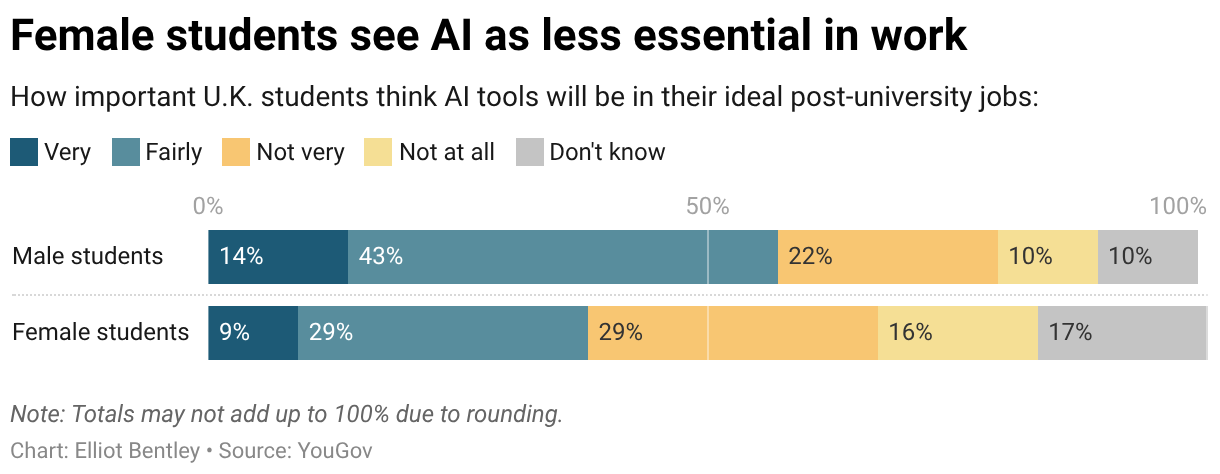
Some of this might come down to the types of subjects that male and female students gravitate towards, where AI software is perhaps more prevalent in male-skewing industries.

On the other hand, the authors of the Harvard meta-analysis took these types of social differences into consideration, and still concluded that “the gender gap in generative AI usage holds across nearly all regions, sectors, and occupations.”
They see this gap as potentially disadvantaging women in the long run:
"Without such efforts [to reduce the gap], AI’s potential to drive economic growth and improve productivity will almost surely disproportionately benefit male users, not only entrenching existing gender gaps, but also opening the possibility that society will miss out on the work, inventions, and ideas women would have produced with this new technology."
However, in that same episode of ‘Stuff Mom Never Told You’, tech commentator Bridget Todd (host of her own podcast, ‘There Are No Girls on The Internet’), questions these assumptions and the idea that women need to be using AI at the same rates as men:
"What are women telling us by not using this technology? Like, should we really just be saying these women are making a bad choice? Shouldn't we really be zeroing in on what women are saying as that pertains to why we are not so gung-ho — to be adopting this technology the way that men are."
Thanks for reading! For the record, I didn’t use any AI to write this post… but maybe I should have? Come back next week for a Weekly Chart from my human colleague Jona.
Notes
*The sources used in this post, unfortunately, do not include figures for nonbinary individuals and bucket all participants into ‘male’ or ‘female’. Another recent study reported that nonbinary, transgender, and disabled people have significantly more negative attitudes toward AI than their cisgender and nondisabled counterparts.
**While this may be true of UK-based students, it doesn’t necessarily represent the views of students globally. An Ipsos survey found that people in different countries had vastly different perspectives on AI; particularly, those in Asia and South America tended to be more optimistic about the potential of AI products and services compared to Western and English-speaking countries.


